

1. Blending (Awase) → Working With Constraints
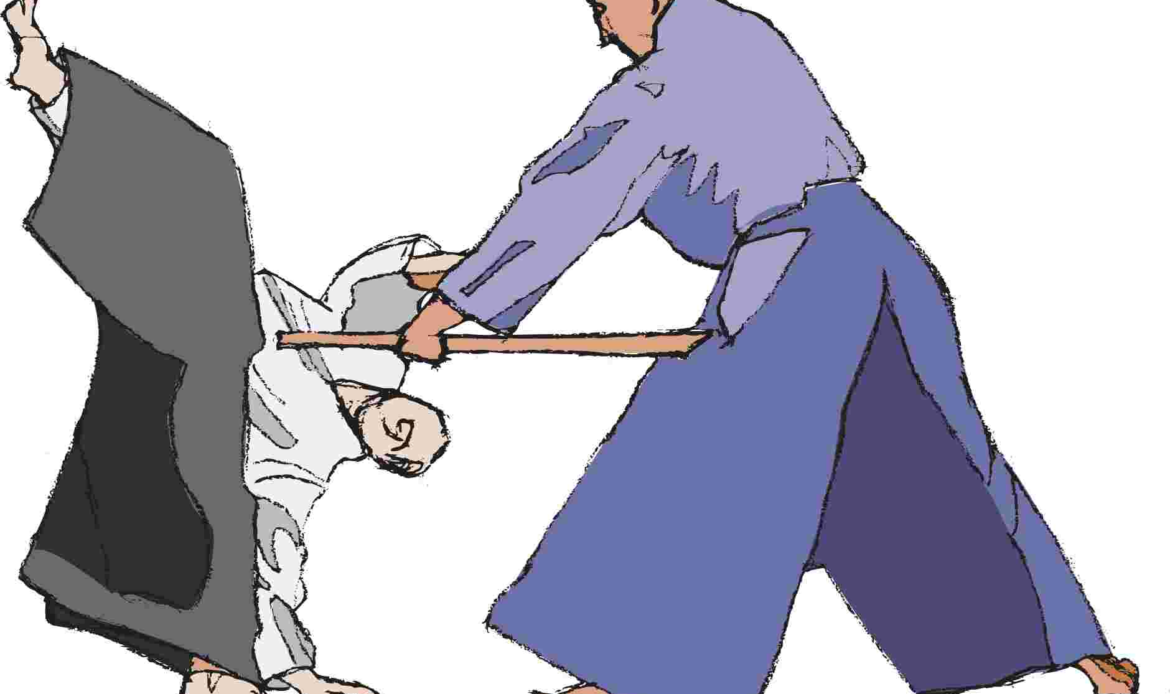
In Aikido, the practitioner blends with the attacker’s movement instead of resisting it.
Creative parallel:
Artists and designers rarely work in a vacuum. They face constraints such as:
- client requirements
- budgets
- materials
- deadlines
- audience expectations
Instead of fighting these limitations, effective creators blend with them and turn them into opportunities.
Example:
A graphic designer might transform strict brand guidelines into a distinctive visual system rather than seeing them as restrictions.
2. Redirection of Energy → Transforming Ideas
Aikido techniques redirect the attacker’s force rather than opposing it.
Creative parallel:
Ideas often emerge by redirecting existing influences:
- cultural references
- historical styles
- mistakes or accidents
Artists frequently turn unexpected outcomes into breakthroughs.
Example: A painting error becomes a new texture or compositional element.
3. Center (Hara) → Conceptual Core
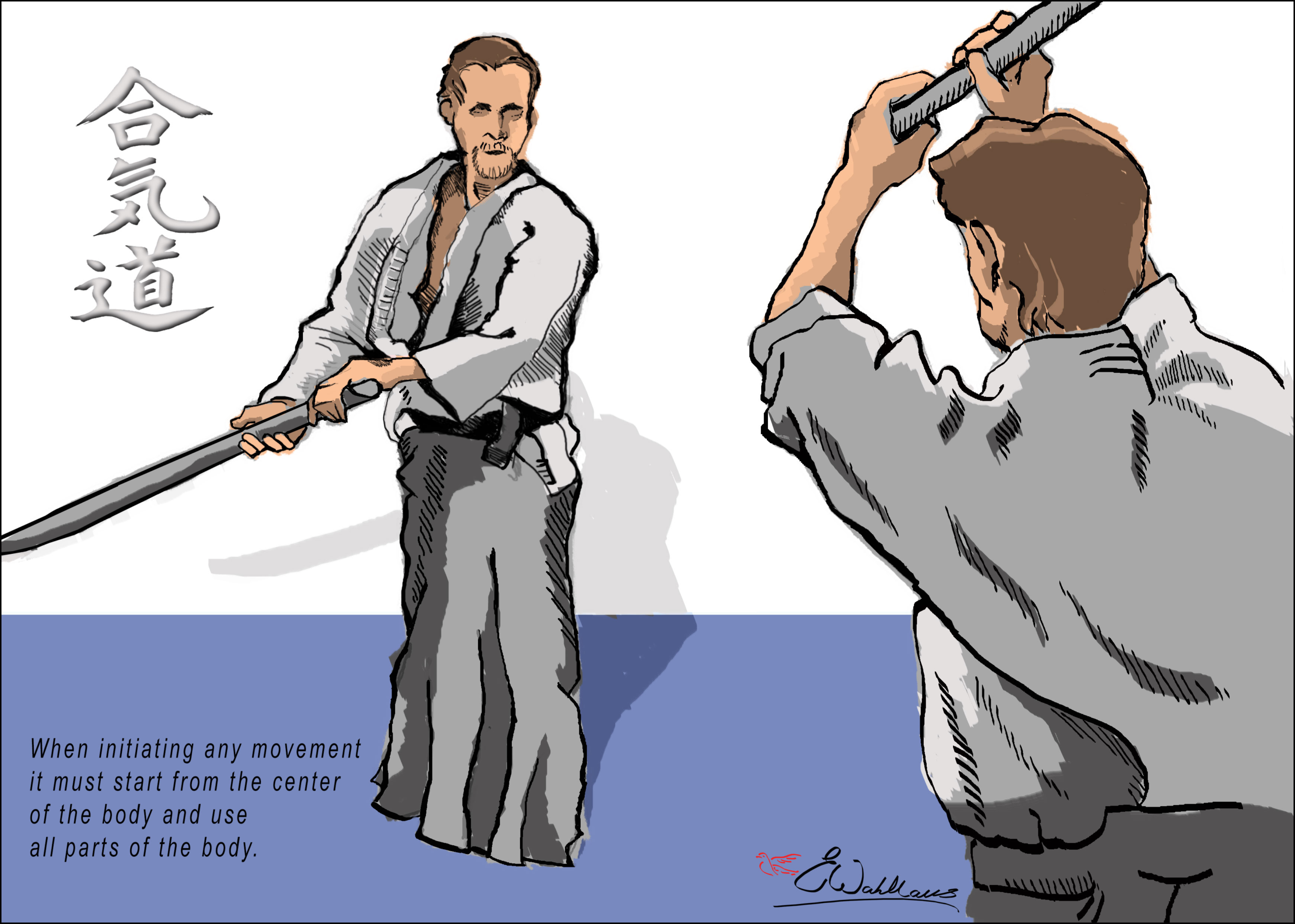
Aikido emphasizes movement from the center of the body (hara) for stability and power.
Creative parallel:
In art and design, the concept or core idea functions like the creative center.
When the concept is strong:
- decisions become clearer
- the composition remains coherent
- the work feels intentional
- Without this center, design becomes scattered.
4. Ma-ai (Spatial Relationship) → Composition and Balance
In Aikido, ma-ai refers to the relationship of distance, timing, and space between practitioners.
Creative parallel:
This is essentially composition in visual art:
- spacing
- proportion
- rhythm
- visual balance
Good design relies on sensitive spatial awareness, much like martial movement.
5. Timing → Creative Intuition
Aikido techniques succeed through precise timing.
Creative parallel:
Creative decisions often rely on intuition and timing, such as:
- knowing when to stop refining
- when to break a rule
- when to change direction in a project
Overworking a design can be like attacking too late—momentum is lost.
6. Economy of Movement → Simplicity in Design
Aikido techniques are often minimal and efficient.
Creative parallel:
Great design frequently follows the principle:
Remove everything that does not serve the idea.
This leads to:
- clean visual hierarchy
- minimalism
- clarity of communication
7. Harmony Rather Than Conflict
The philosophical foundation of Aikido is harmonizing conflict rather than defeating an opponent.
Creative parallel:
In collaborative creative environments (design studios, architecture teams, editorial processes):
- different viewpoints interact
- ideas clash
- solutions evolve through integration
The best results come from harmonizing perspectives rather than dominating them.
8. Continuous Practice → Iterative Creation
Aikido mastery comes through repetition and refinement.
Creative parallel:
Artistic mastery comes from:
- sketching
- prototyping
- revisions
- experimentation
Creativity is iterative practice, not sudden inspiration.
In Summery
Aikido teaches how to work with energy, structure, and relationships rather than forcing outcomes. The same mindset guides strong creative practice.
Both disciplines involve:
- sensitivity to movement and form
- awareness of space and balance
- responsiveness to changing conditions
- and development through continuous practice
Aiki Flow: The first 3 Character Traits for Personal Development
Bookshelves are full of countless books claiming to be the most comprehensive instructional manuals for facilitating Personal Development. Do I now suggest that where all others have failed, AikiFlow has succeeded? In a nutshell, “no”.
Meaningful change is far from easily achieved, and there is no one solution that fits all. Human nature and behavior often work on the logic of: “Since you are still around, what you have been doing until now must be a good enough strategy to keep doing”. Human nature prefers the status quo, for better or worse, making true, meaningful change difficult.
However, let me suggest a different approach to human behavior. Human behavior is continually being molded and changing; every decision you make alters your behavior. For example, in a situation where you have two options for responding—one honest and the other dishonest—if you act dishonestly, your overall behavior shifts toward dishonesty. Likewise, if you choose the honest response, your overall behavior moves toward being more honest.
If this were the whole story, why is real change so difficult to achieve? The answer lies in the issue of momentum. For example, if you make three dishonest choices or even just one, it creates momentum so that you continue making dishonest choices. Therefore, the next time you have a choice between being honest or dishonest, because the momentum already exists, it is more likely you will choose to be dishonest.
Furthermore, the momentum created by three dishonest decisions cannot be countered simply by three choices to be honest. To counter that momentum and create momentum in the opposite direction will require five, ten, or more choices to be honest. Now that we have a better working picture of the problem, we can ask: what tools are available to help us change our behavior?
Let’s look at two character development models that have stood the test of time. They both outline a program for character development. The first is a treatise by Takuan Soho, a Japanese Zen monk and poet (circa 1573), titled The Mysterious Record of Immovable Wisdom. The second is by Moshe Chaim Luzzatto, a Kabbalist (1707–1746), whose monumental work mapping out spiritual development is titled The Path of the Just.
Takuan describes the ideal mind as being the mind that is not detained or “stopped” in any way. As a beginner is ignorant about body posture or the positioning of a sword, his mind does not “stop” anywhere within him. However, as he is taught diverse ways to take a stance or grasp his sword, his mind begins to “stop” in many places. Later, as days pass and practice accumulates, neither the postures of his body nor the ways of grasping the sword are weighed in his mind; his mind returns to the state it was in the beginning, when he knew nothing at all, but now he has attained the ideal mind.
Takuan continues with examples of how to achieve this ideal unstopping mind, beginning with the “Action of Spark and Stone“. No sooner have you struck the stone than the light appears; because the light appears just as you strike the stone, there is neither interval nor interstice. This signifies the absence of the interval that would “stop” the mind. This characteristic of immediate response when action is required is a foundational trait that is also found in The Path of the Just.
Luzzatto defines his goal in his introduction: “There are few, however, who devote thought and study to perfection of Divine service—to love, fear, communion and all other aspects of saintliness”. While Luzzatto’s ultimate goal is different from Takuan’s, their processes to achieve these goals are very similar. Luzzatto, a systematic thinker, clearly lists the stages necessary for proper character developement: Torah (study) leads to Watchfulness, which leads to Zeal, which leads to Cleanliness, which leads to Separation which leads to Purity and so on.
In Luzzatto’s system, change is a linear progression where each stage is built on the preceding one. Initially, there may be no awareness of the need for change; then, through study, that need for change is realized. This begins the stage of Watchfulness: paying attention to the present moment, recognizing what actions need change, and identifying what must be avoided.
Following immediately on the heels of awareness is Zeal, or action. Zeal is not simply acting, but emphasizes immediate action. This is the key to cementing change and progressing to the next stage: Cleanliness. Cleanliness in this context refers to paying attention to the quality of the action undertaken, ensuring it is performed with the highest integrity and correctness.
Takuan, being a poet first, does not follow Luzzatto’s systematic approach in his writing. However, if we look carefully, we can see the same foundational character traits for real change. Takuan starts with the beginner who is unaware of the need for change; but as the student studies and becomes aware of his deficiencies, he is “extraordinarily discomforted”. This corresponds to Luzzatto’s Watchfulness. Takuan then explains how the student trains with correct techniques to start his journey toward change.
Takuan’s first description of his process is the “Action of the Spark and the Stone”—where the light appears the instant the stone is struck—signifies an absence of the interval that would “stop” the mind. This is perfectly aligns with Luzzatto’s Zeal. This immediate, decisive action becomes the foundation upon which all future progress is built.
Ultimately, change is not a singular event but a continuous process of overcoming existing momentum. By cultivating Watchfulness—the keen awareness of our current state—and Zeal—the immediate, spark-like action required to shift our direction—we lay the groundwork for Cleanliness, where our actions must be further defined by integrity rather than habit. Whether viewed through the lens of a Zen monk or a Kabbalist’s the path to character transformation begins fisrtly with the recognition that every choice we make either feeds our old momentum or strikes the spark for a new way of being. Secondly that every actions either reinforce change or perpetuate old habits. Finally with continuous positive actions true change can be achieved.
The Foundational Lesson of Ukeme
If you look at most teaching manuals they are essentially Nage centric in their approach to teaching Aikido, perhaps in the beginning of the manual there will be a brief description of how to fall, how to do a forward roll, backward roll, knee walking and so on. However the focus of most manuals are the movements of Nage with little explanation about Uke. To better understand Aiki a better grasp of Ukemi is required. Ukemi in this context refers to the movements of uke not only how they preform the attacks but equally how they respond to nage’s defensive techniques.
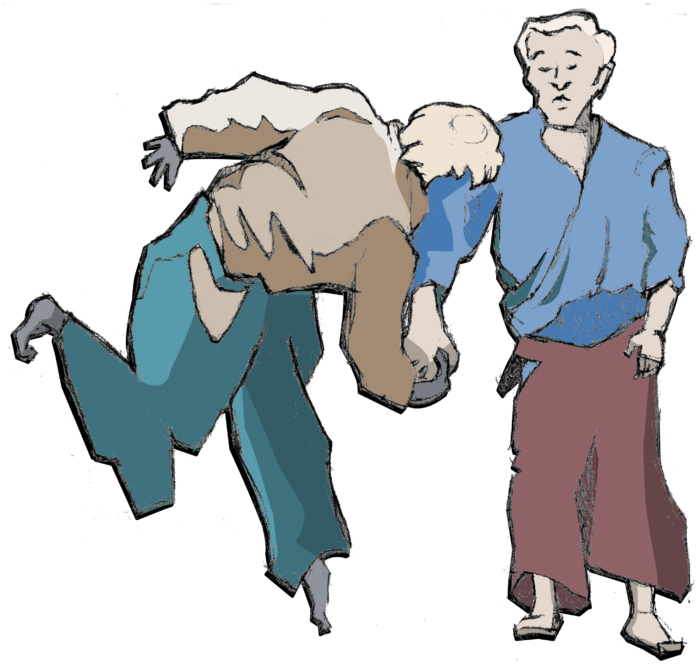
In a presentation by Henry Kono, he stresses the role of uke (the person receiving the technique) is not that of a passive victim, but of an active participant essential to the discovery of balance. Kono emphasizes that “there is no victim in Aikido”; rather, the uke and nage (the defender) function as two halves of a single, unified whole striving always to be in balance.
The Foundational Lesson of Ukeme
Practicing ukemi, falling and receiving of nage’s techniques should be treated as a prerequisite before focusing on the techniques like throwing. This extended period as an uke is critical for several reasons:
Body Awareness: Taking ukemi (falling) creates a deep awareness of the body that cannot be achieved by focusing solely on throwing.
Instinctive Movement: After years of following, uke begins to understand how to move automatically. Eventually, uke doesn’t need to be “taught” techniques because they have learned the underlying principles of movement through their own body.
Safety: By learning to drop their center, stay grounded, and stay loose, uke learns how to get their body out of the way of an attack—such as a sword—to avoid injury.
Following and “Lightness”
The goal of uke is to follow the nage exactly without resistance. Kono explains that resistance or “dragging” makes an uke feel heavy and creates conflict.
Becoming Light: An uke becomes “light” by following the defender’s movement so closely that it is difficult to distinguish who is actually performing the technique.
Timing: Uke aims to move at the exact same time as nage, leaving no space or delay between their actions.
The Opposite Nature: Balance between uke and nage requires uke to be doing the “very opposite” of what the *nage* is doing, thus ensuring the two remain in harmony.
The “Stop Point” and Intent
Kono introduces the concept of the “stop point” to explain the interaction between uke and nage, the contact point between nage and uke that neither can pass.
Non-Interference: uke must not push into or invade the space of the nage.
Continuous Intent: While uke must not push past the point of contact, they must keep their energy “coming out” or going forward. If the uke stops their intent or pulls back, they become “heavy” and lose the connection.
Spontaneous Turning: When uke maintains this forward intent but respects the “stop point” where they touch nage, their body will naturally and automatically begin to turn, leading to the throw without the need for brute force.
Technical Integrity
A good uke must also be honest in their attack to help the nage learn. If uke just “stands there” or holds with the intent to stop the other person, they are not practicing Aikido principles. A honest attack is characterized by:
Dropping the Center: Instead of leading with the shoulders, which creates stiffness, uke must practice bringing their center / awareness down to stay mobile and responsive.
Keeping the Center Between the Hands: Just like nage, uke should keep their hands aligned with their own center to maintain good posture.
Ultimately, Kono argues that if the uke does not improve and understand these principles, then as nage they will never truly comprehend the art, as the two are inextricably linked.
There was once a time—at least in the memory of man—when the world was not divided between the seen and the unseen. Mountains were not simply stone, forests were not merely collections of trees, and rivers did not flow as lifeless streams across the earth. Every element of nature possessed a spirit, a presence, a voice. It was an age when man lived not apart from mystery, but within it. This was the age of fairy tales.
Across nearly every culture, ancient stories begin with some variation of “long ago” or “once, in another time.” Yet these phrases do not simply place the story in the distant past. They point to an entirely different relationship between humanity and the world—a period when the boundaries between mortals, gods, spirits, and unseen forces were fluid and permeable.
In the forests of Europe, travelers encountered fairies, elves, and trolls who could bless or curse with equal ease. In the deserts of the Middle East, djinn whispered through the sands. Among the Celtic peoples, lakes, stones, and ancient trees were thought to be gateways into the Otherworld. In Africa, ancestral spirits walked beside the living, guiding tribes and protecting sacred lands.
And in Japan, perhaps nowhere was this connection between the human and spirit worlds more delicately expressed than in its ancient tales. Rooted in the spiritual traditions of Shinto, the Japanese worldview saw “kami”—divine spirits or energies—dwelling within mountains, streams, animals, and even the wind itself. The natural world was not separate from the sacred; it was the sacred.
These stories were never merely entertainment. Fairy tales served as maps for living. They taught humility before nature, respect for unseen forces, and the consequences of greed, pride, or broken promises. They reminded listeners that every action creates ripples beyond the physical world.
Perhaps what makes these tales endure is that they speak to something modern life often forgets—that mystery still exists just under the surface. Though we live in an age of science, technology, and endless information, there remains a quiet longing to believe that the world holds more than what our eyes can comprehend.
They remind us that behind an old willow tree, within the mist of a mountain path, or in the silence between falling leaves, another presence is watching.
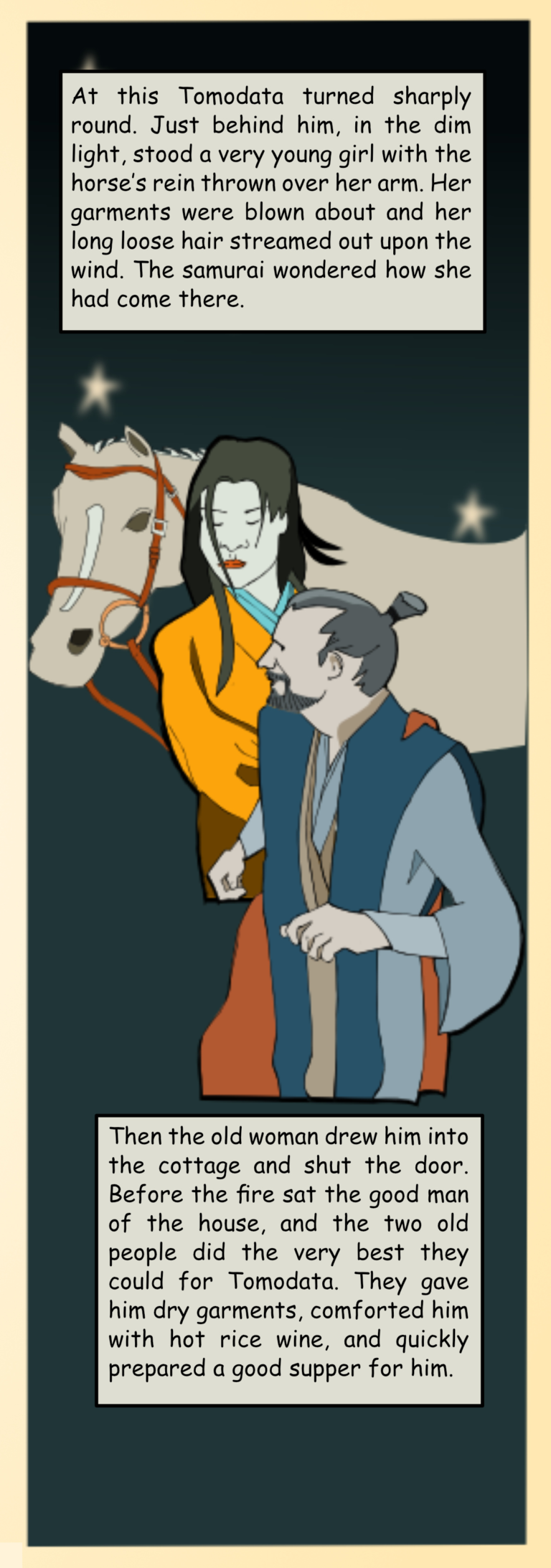
It is this timeless world—where duty, honor, and the spirit realm intertwine—that inspired the graphic novel “Tomodata: The Young Samurai.” Drawing from the classic Japanese fairy tale “Green Willow,” “Tomodata” reimagines that ancient age when man and spirits walked the earth together. Through the journey of a young samurai, the story invites readers back into a world where courage is tested, beauty hides behind illusion, and the supernatural is never far from the path.