
The Age of Fairy Tales
When Man and Spirits Walked Together
There was once a time—at least in the memory of man—when the world was not divided between the seen and the unseen. Mountains were not simply stone, forests were not merely collections of trees, and rivers did not flow as lifeless streams across the earth. Every element of nature possessed a spirit, a presence, a voice. It was an age when man lived not apart from mystery, but within it. This was the age of fairy tales.
Across nearly every culture, ancient stories begin with some variation of “long ago” or “once, in another time.” Yet these phrases do not simply place the story in the distant past. They point to an entirely different relationship between humanity and the world—a period when the boundaries between mortals, gods, spirits, and unseen forces were fluid and permeable.
In the forests of Europe, travelers encountered fairies, elves, and trolls who could bless or curse with equal ease. In the deserts of the Middle East, djinn whispered through the sands. Among the Celtic peoples, lakes, stones, and ancient trees were thought to be gateways into the Otherworld. In Africa, ancestral spirits walked beside the living, guiding tribes and protecting sacred lands.
And in Japan, perhaps nowhere was this connection between the human and spirit worlds more delicately expressed than in its ancient tales. Rooted in the spiritual traditions of Shinto, the Japanese worldview saw “kami”—divine spirits or energies—dwelling within mountains, streams, animals, and even the wind itself. The natural world was not separate from the sacred; it was the sacred.
These stories were never merely entertainment. Fairy tales served as maps for living. They taught humility before nature, respect for unseen forces, and the consequences of greed, pride, or broken promises. They reminded listeners that every action creates ripples beyond the physical world.
Perhaps what makes these tales endure is that they speak to something modern life often forgets—that mystery still exists just under the surface. Though we live in an age of science, technology, and endless information, there remains a quiet longing to believe that the world holds more than what our eyes can comprehend.
They remind us that behind an old willow tree, within the mist of a mountain path, or in the silence between falling leaves, another presence is watching.
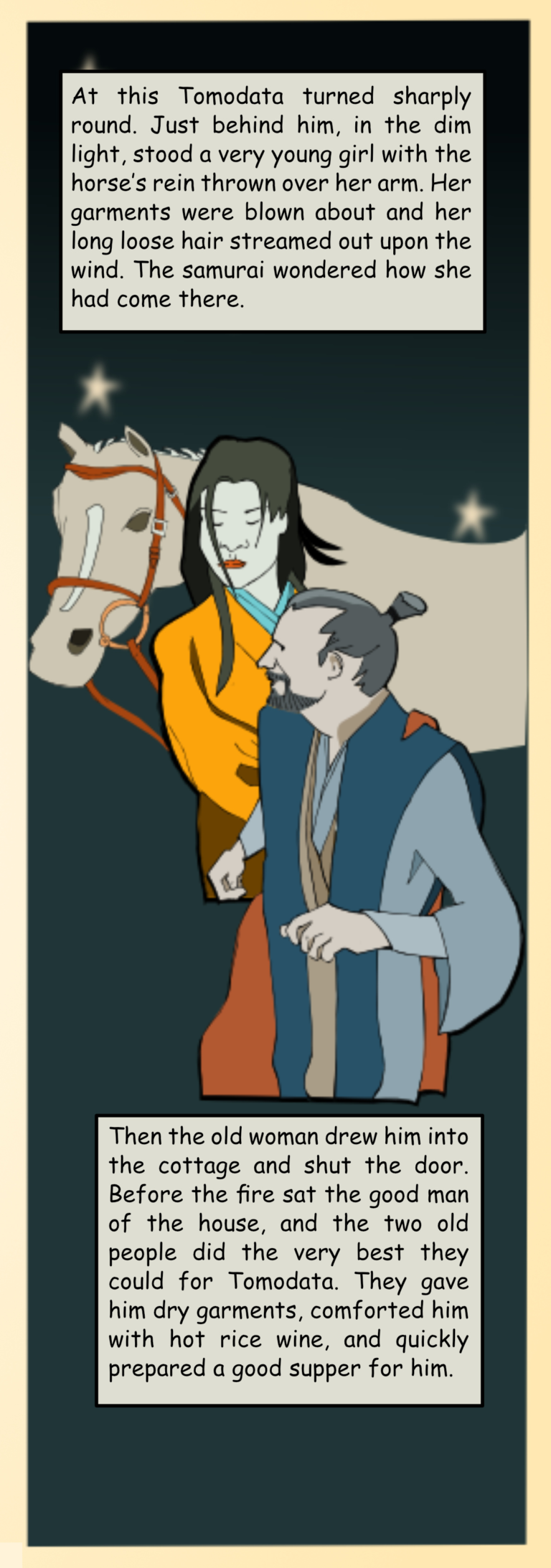
It is this timeless world—where duty, honor, and the spirit realm intertwine—that inspired the graphic novel “Tomodata: The Young Samurai.” Drawing from the classic Japanese fairy tale “Green Willow,” “Tomodata” reimagines that ancient age when man and spirits walked the earth together. Through the journey of a young samurai, the story invites readers back into a world where courage is tested, beauty hides behind illusion, and the supernatural is never far from the path.